Designing Silicone Comfort Interfaces for Smart Glasses and Wearable Electronics
Discover how silicone product development in 2026 is moving from basic plastic replacement to high-performance application engineering across baby, kitchen, travel, and pet product sectors.
Designing Silicone Comfort Interfaces for Smart Glasses and Wearable Electronics
Designing soft contact interfaces for smart glasses and wearable electronics requires looking beyond simple material elasticity. High-performance wearable design is never just about specifying "soft silicone." When an electronic device sits against the human body for extended periods, the soft interface becomes the primary physical junction balancing thermal conduction, localized pressure distribution, mechanical retention, cable/component routing, and long-term hygiene.
As wearable hardware grows denser—integrating micro-displays, spatial audio, sensors, and processing chips—mechanical and industrial designers must engineer skin-contact silicone interfaces that harmoniously co-exist with internal heat paths, delicate PCBAs, and complex ergonomic constraints.
1. Why Wearable Comfort Is a System Requirement
Comfort in wearable electronics is rarely a standalone property of the elastomeric material. It is a dynamic systemic outcome resulting from structural weight distribution, thermal energy transfer, and localized skin mechanics.
When a user experiences "wearable fatigue," the root cause is seldom the hardness of the silicone alone. Rather, it is typically caused by localized pressure spikes on cranial contact points, trapped sweat along non-breathable seal lines, or conductive heat migration from adjacent processing components. Treating the silicone wearable interface design as a holistic mechanical system ensures that soft components actively mitigate hardware constraints rather than masking them.
2. Map Heat Sources Before Designing the Soft Interface
Before defining the geometry or Shore durometer of a nose bridge or temple pad, engineering teams must evaluate the thermal topology of the underlying electronics. Internal heat generators—such as battery protection circuits, micro-projectors, wireless transceivers, or specialized micro-speakers (e.g., solid-state MEMS speaker modules like xMEMS XMC-1200)—transfer thermal energy outward through the frame architecture.
Silicone elastomeric materials naturally act as thermal insulators (typical thermal conductivity $\approx 0.2 \text{ W/m}\cdot\text{K}$). If a soft interface directly covers an unshielded heat source, thermal energy accumulates inside the housing, degrading component longevity and elevating skin-contact temperatures. Designers must create thermal bypass channels, integrate conductive fillers where heat dissipation is required, or introduce air gaps between the rigid frame and the soft skin pad.
3. Pressure Distribution at the Temples, Nose and Skin
Ergonomic comfort requires maintaining skin-contact pressure well below capillaries' occlusion thresholds (typically under 4.0 kPa / 30 mmHg). Smart glasses present unique challenges due to front-heavy mass distributions caused by optical engines and display prisms.
- Nose Bridge Pads: Require variable-thickness cross-sections to distribute vertical gravitational loads evenly across the nasal bones without pinching cartilage.
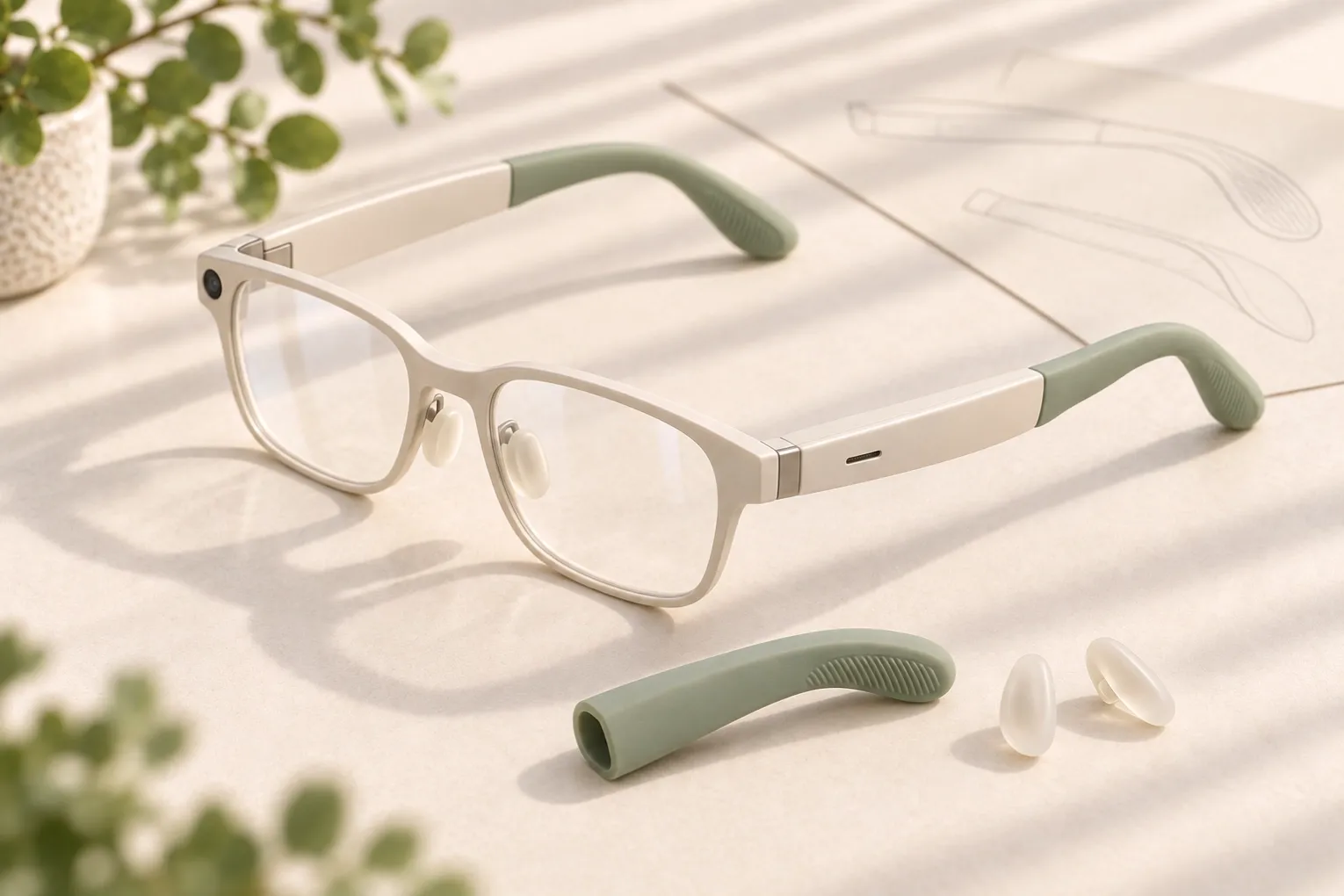
- Smart Glasses Silicone Temple Sleeves: Must balance lateral clamping forces behind the ear. Silicone geometry should feature internal hollow ribs or air-cushioned cavities that deform progressively under load.
- Skin Contact Interface: Sharp transitions in structural stiffness generate shear stress on epidermal tissue. Silicone geometries must feature soft radius transitions to smooth out load gradients.
4. Hardness, Thickness and Local Geometry
Specifying a single Shore hardness for a wearable silicone part is a common design flaw. A 40A durometer silicone can feel excessively rigid if the wall thickness exceeds 3.0 mm, or flimsy and unstable if thinner than 0.8 mm.
Geometric Guidelines for Skin-Contact Silicone DFM:
- Wall Thickness Gradients: Maintain minimum wall thicknesses of 1.0–1.2 mm for Liquid Silicone Rubber (LSR) injection molding to guarantee complete mold cavity filling without flash.
- Progressive Durometer Mapping: Utilize soft inner zones (20A–30A) for direct skin contact merged with stiffer mounting bases (50A–60A) to secure the part onto the rigid frame.
- Micro-Ribbing & Hollow Cores: Incorporate internal compression voids to allow structural deflection without requiring ultra-soft, tear-prone raw materials.
5. Separate Sleeve, Mechanical Retention or Overmolding?
Choosing the correct integration method dictates both tooling investment and manufacturing efficiency. Engineering teams generally evaluate three structural approaches:
- Removable Separate Sleeves: Slide-on silicone sleeves are cost-effective and easy to replace. However, they rely strictly on frictional engagement, which can stretch or slip over extended use cycles.
- Mechanical Snap Retention: Silicone components molded with internal undercut lips that snap onto rigid substrate tabs. This requires careful consideration of silicone tear strength and draft angles during tool design.
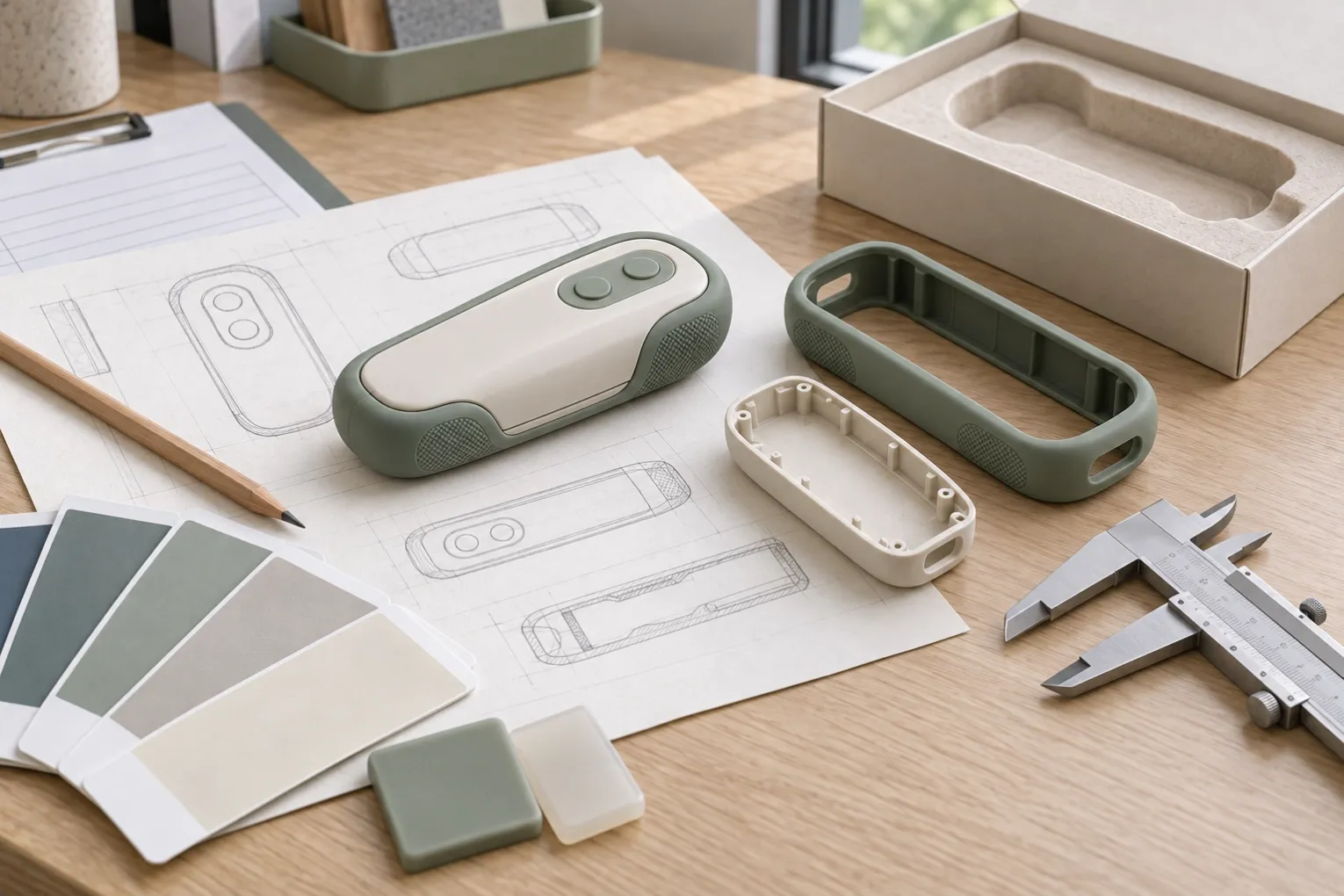
- Wearable Silicone Overmolding: Direct multi-shot molding of LSR over thermoplastic substrates (e.g., Polycarbonate, TR90, or PA12). This creates a permanent chemical/mechanical bond, delivering pristine aesthetic integration and zero fluid ingress, but requires strict substrate heat tolerance.
6. Airflow, Venting and the Risk of Trapping Heat
Hermetic silicone seals create a barrier against moisture, but when pressed against human skin, fully sealed surfaces trap perspiration and ambient thermal energy. In wearable environments, trapped moisture reduces the skin's friction coefficient, leading to slippage and localized dermatitis.
To preserve breathability, silicone comfort pad design should incorporate micro-ventilation channels, recessed airflow grooves, or textured micro-patterns on skin-facing surfaces. These geometric features allow sweat evaporation and passive ambient air circulation without compromising structural retention.
7. Sweat, Sebum, Cleaning Agents and UV Exposure
Wearable devices operate in harsh chemical environments, exposed daily to human sebum, acidic sweat, cosmetics, alcohol cleaning wipes, and direct sunlight.
- Material Selection: Platinum-cured Liquid Silicone Rubber (LSR) is mandatory for skin-contact wearables to eliminate peroxide residues and prevent yellowing over time.
- Surface Finishes: Raw silicone naturally possesses a high coefficient of friction, attracting lint and dust. Specifying specialized oleophobic/hydrophobic spray coatings or texturing the mold surface (SPI-B1 to SPI-C1) significantly reduces tackiness and improves tactile feel.
- Chemical Resistance: Ensure material formulations pass ISO 10993-5 (Cytotoxicity) and ISO 10993-10 (Irritation and Sensitization) testing after exposure to artificial perspiration solutions.
8. Fit Sizes, Replacement and Tolerance Control
Human cranial and facial morphology varies dramatically across demographics. For high-end smart glasses, offering modular, interchangeable comfort components (e.g., Small, Medium, Large nose pads or temple cushions) is vital for universal fit.
Unlike rigid plastics, silicone exhibits thermal shrinkage rates ranging from 1.5% to 3.0% depending on the specific filler content and curing temperatures. Tool designers must precisely calculate volumetric shrinkage factors during mold tooling development to ensure that interchangeable silicone pads maintain tight mating tolerances ($\pm 0.05 \text{ mm}$) with the rigid eyewear frame (as seen in modular adjustment frameworks like Even G2 fit guidelines).
9. A Thermal–Pressure–Retention Prototype Test Plan
Before locking in high-cavitation production tooling, engineering teams should execute a comprehensive physical testing protocol on prototype LSR or high-resolution silicone parts:
- Thermal Mapping: Equip prototype frames with thermocouple sensors and FLIR thermal imaging to monitor skin-interface surface temperatures under full electronic processing load (aiming to keep skin contact below 41°C).
- Tactile Pressure Profiling: Utilize ultra-thin flexible pressure sensor arrays placed beneath temple sleeves and nose bridges to identify localized pressure spikes during dynamic head movements.
- Cycle & Retention Testing: Subject mechanical snap-fit joints and overmolded interfaces to 5,000+ insertion/removal cycles and artificial sweat immersion to verify bond integrity and tear resistance.
10. What to Include in a Wearable Silicone RFQ
To receive an accurate Design for Manufacturability (DFM) review and tooling quote from an OEM manufacturing partner like Esky Supply, your Request for Quote (RFQ) package should contain:
- 3D CAD models (.STEP / .IGS) displaying both the soft silicone component and the mating rigid hardware interface.
- Target Shore A durometer specifications and surface finish requirements (e.g., matting texture or anti-dust coating).
- Operating environmental parameters (expected thermal exposure, sweat contact, IP water-resistance ratings).
- Biocompatibility and regulatory compliance targets (FDA 21 CFR 177.2600, ISO 10993, REACH/RoHS).
- Annual estimated volume requirements to optimize mold cavitation strategy (e.g., single-cavity prototype vs. multi-cavity automated LSR tooling).
Developing a Skin-Contact Wearable Component?
Whether you are integrating silicone with rigid structural frames or embedded electronics, Esky Supply provides expert DFM, precision LSR tooling, and volume manufacturing.
Request a DFM & Manufacturability Review